Numbers
Percentages in real life
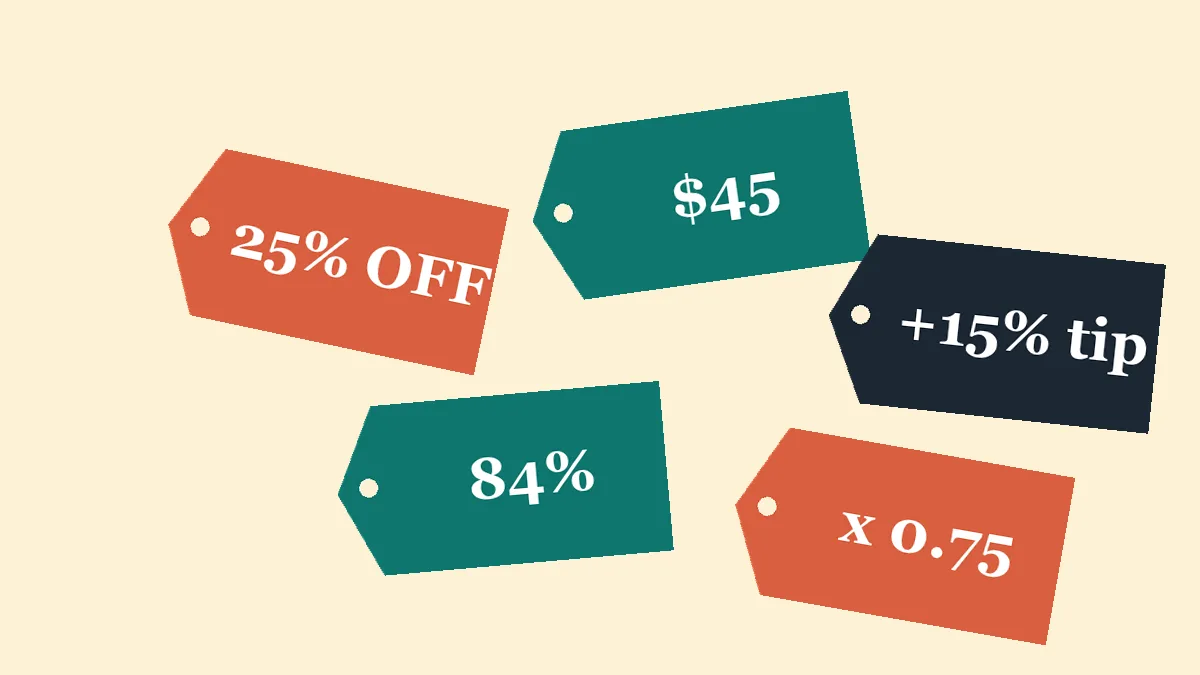
Percentages are everywhere once you start looking: on sale signs, phone batteries, weather forecasts, test results and news headlines. The good news is that they all use the same small idea.
What "percent" really means
Per cent means "for every hundred". When a shop says 30% off, it means that for every $100 of price, $30 comes off. Writing a percentage as a decimal makes it easy to use: 30% is 0.30, 5% is 0.05, and 150% is 1.5.
At the shops: working out a discount
A pair of sneakers costs $60 and is 25% off. There are two quick ways to find the sale price.
- Find the discount, then subtract. 25% of 60 is 0.25 x 60 = $15. The sale price is 60 - 15 = $45.
- Find what is left in one step. If 25% comes off, you pay 75%. 0.75 x 60 = $45.
The second method is faster, and it is the one to use when a discount is taken off an already-reduced price. A "further 10% off" sale price of $45 is 0.9 x 45 = $40.50, not 35% off the original. Two discounts do not simply add up.
At a restaurant: the tip
To tip 15% on a $40 bill in your head, find 10% first by moving the decimal point one place left: $4. Half of that is 5%: $2. Add them: $6. For 20%, just double the 10%: $8. This "find 10% first" trick works for almost any percentage you need quickly.
At school: turning scores into percentages
You got 34 out of 40 on a science test. Divide the score by the total and multiply by 100: 34 ÷ 40 = 0.85, so 85%. If the test was out of 25 and you got 21, that is 21 ÷ 25 = 0.84, or 84%. Percentages let you compare tests that had different totals, which is why report cards use them.
In the news: increases and decreases
"Ticket prices rise 20%" means the increase is 20% of the old price. If a ticket was $50, it rises by $10 to $60. Here is the trap: if the price then falls by 20%, it does not go back to $50. 20% of $60 is $12, so it drops to $48. Each percentage is taken from whatever the number was at that moment.
The same thinking explains why a headline like "cases doubled" sounds frightening even when the numbers are tiny. Going from 2 to 4 is a 100% increase. Always ask: a percentage of what?
Percent versus percentage points
If your class's pass rate rose from 60% to 75%, it went up by 15 percentage points. But as a percentage of the old rate, it went up by 25% (15 is a quarter of 60). Both are true. They just answer different questions, and careful writers say which one they mean.
Quick reference
| Question | Method | Example |
|---|---|---|
| What is 30% of 70? | 0.30 x 70 | 21 |
| 18 is what % of 24? | 18 ÷ 24 x 100 | 75% |
| Price after 25% off $60 | 0.75 x 60 | $45 |
| Change from 40 to 50 | (50 - 40) ÷ 40 x 100 | +25% |
Keep reading
 NumbersFractions explained with pizzaUnderstand fractions with pizza: what the top and bottom numbers mean, equivalent fractions, adding slices of different sizes and dividing by a fraction.
 GradesHow GPA is calculatedA plain-English guide to grade point average: how letter grades become points, why credits matter, weighted vs unweighted GPA and how to raise yours.
 NumbersMental math tricks every student should knowSpeed up your arithmetic with simple mental math tricks: multiplying by 5, 9 and 11, squaring numbers ending in 5, quick percentages and estimating.