Study skills
How to study for a math test
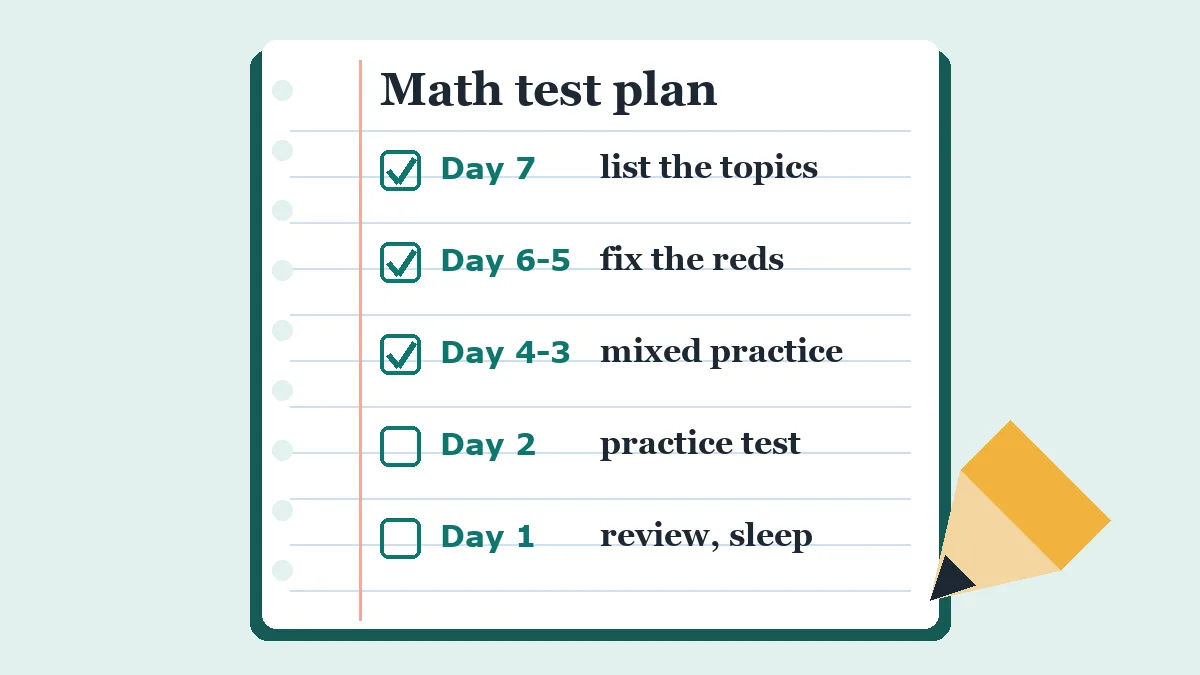
Math is a skill, not a list of facts. Reading your notes over and over feels like studying, but it does not build the skill. Doing questions does. This plan spreads the work over a week so that nothing has to be crammed.
Day 7: find out what is on the test
Ask your teacher which topics are included and look at the chapter headings. Make a short list, one line per topic. Then rate each one honestly: green (I can do this), amber (I sort of can), red (I am lost). This list is your plan for the week.
Days 6 and 5: work on the reds
Start with the hardest topics while there is plenty of time. Re-read the worked example from class, then cover it and try to reproduce it without looking. Then do three or four similar questions. If you get stuck, look only at the next line of the solution, not the whole thing.
Days 4 and 3: mixed practice
Real tests mix topics, so your practice should too. Take questions from different sections and do them in a random order. This feels harder than practising one topic at a time, and that is exactly why it works: you are learning to recognise which method a question needs.
Day 2: a practice test under real conditions
Use an old test or a set of textbook review questions. Time yourself, put your phone away, and do it in one sitting. Then mark it. Every mistake goes on a "fix list" with a one-line note about what went wrong: a sign error, a forgotten formula, a misread question.
Day 1: review, do not cram
Go through your fix list and redo those questions. Write the key formulas on one page and read it a couple of times. Pack your bag, check your calculator, and go to bed at a normal time. A tired brain makes careless mistakes that no amount of revision can fix.
On the day
- Read the whole paper first. Start with a question you are sure of to build momentum.
- Show your working. Method marks can rescue a question even if the final answer is wrong.
- Estimate, then check. If a question asks for the height of a person and you get 47 metres, look again.
- Leave five minutes at the end to reread your answers and check units.
Using a calculator to study
A step-by-step calculator is a great study partner if you use it after trying a question, not before. Compare its working with yours. The first line where they differ is the exact thing to practise. Over a week, those small fixes add up to a much better score.
Keep reading
 NumbersFractions explained with pizzaUnderstand fractions with pizza: what the top and bottom numbers mean, equivalent fractions, adding slices of different sizes and dividing by a fraction.
 NumbersPercentages in real lifeLearn percentages through real situations: sale prices, tips, test scores and news headlines. Includes mental math shortcuts and common traps to avoid.
 GradesHow GPA is calculatedA plain-English guide to grade point average: how letter grades become points, why credits matter, weighted vs unweighted GPA and how to raise yours.